
Huskies versus Poodles
The Gripen versus the F-35

The PR campaign for the F-35 is picking up speed – that is, the PR campaign to push the Canadian government to choose the U.S. fighter over the Swedish Gripen.
A campaign like this requires a big budget. Fighters are the showgirls of weaponry. Elegant. Difficult to handle. Fast to slip away from you. And extremely expensive. If you’re not careful in your choice, you may find that the upkeep over time is the most expensive part of the bargain.


All of that to say that PR budgets to sell fighters are terrifying. And the U.S. arms industry as a whole is built on unparalleled PR.
Plus incredible technology. Plus the reality that convincing countries to buy their military equipment is central to U.S. power. People who buy their equipment become dependent on the U.S. government and on U.S. manufacturers for spare parts. Spare parts are an incredibly powerful tool in the hands of a seller who wants to increase their influence over the buyer.
Let me put this in slightly different terms. The U.S. manufacturers of weapons always have big PR budgets. Billions of dollars are at stake, so why not spend a fortune on PR. The reputation and influence of the United States is at stake. Over the last 75 years, the U.S. has increasingly built a central part of its economy around an internal circuit of government and arms producers. The good old Military-Industrial Complex.
In the beginning it wasn’t all that complex. Just the military and the armaments industry. In the early 1960s, a third element was added on. This consisted in a delusional idea that governments could make money out of armaments by selling them to third parties all over the world.
The arms industry lobbies turned this into a respectable economic theory. John Kennedy, Charles de Gaulle and Harold Macmillan plus their advisors were the architects of this policy which has always been, how shall I put it, silly from the economic point of view. The more your economy becomes dependent on the production and distributing of weapons, the less it has a relationship to any kind of marketplace, whether capitalist or social democratic or a mix of the two.
Weapons have no value in and of themselves. And they are not the basis for developing a balanced economy.
In Voltaire’s Bastards: The Dictatorship of Reason in the West (1992), I included a long chapter (“The Flowering of Armaments”) laying out this new model.
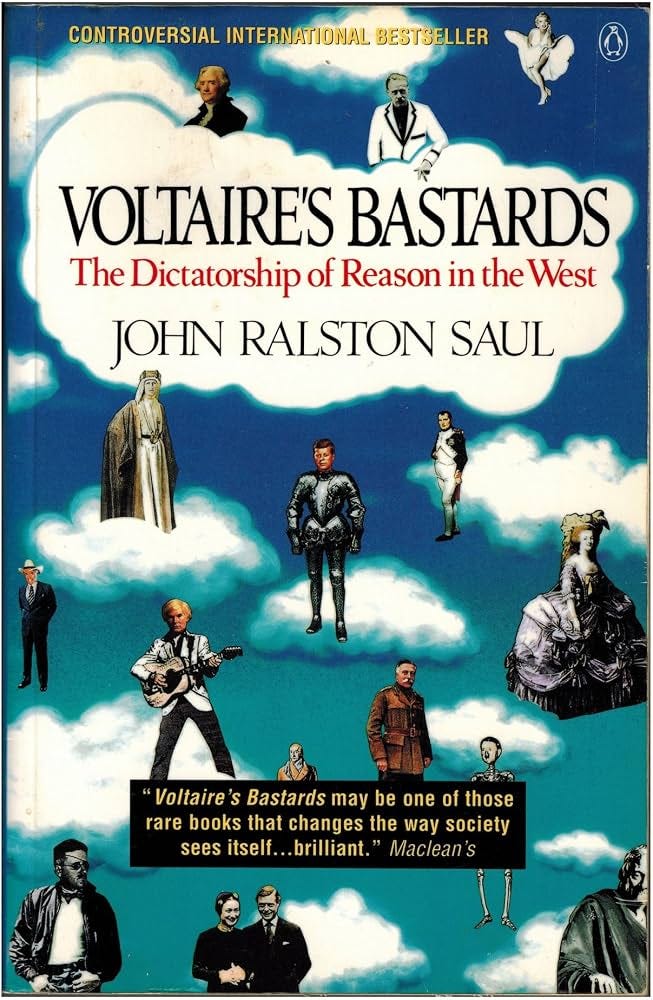
I can’t exactly say that I’m happy to have gotten it so exactly right 34 years ago. But I suppose it’s better than getting it completely wrong. Here’s how the chapter begins:
We are living in the midst of a permanent wartime economy. The most important capital good produced in the West today is weaponry. The most important sector in international trade is not oil or automobiles or airplanes. It is armaments…
By any standards – historic, economic, moral, or simply practical – in a healthy economy arms would not occupy first place unless that society were at war. Even then, such prominence would be viewed as an aberration to be put up with no longer than events required.
Weapons are not a growth sector. Why? Because this is an industry which involves selling the sort of goods that either sit around contributing nothing (a missile, a rifle, etc.) or are used. In the case of any kind of bomb or missile, once used they cease to exist. Boom and they’re gone.
As I said, the modern arms market has always been delusional. What kind of economics does it represent? – an economy of hysteria.
- - -
Nevertheless, here we go again.
And let’s not become obsessed by Canada and the choice it must make. Let’s focus instead on Washington. Selling the F-35 to Canada matters to Washington for three reasons.
First, this would ensure a new and accentuated stage of U.S. control over the Canadian military and therefore Canadian defence policy.
Second, this would undermine Canada’s current efforts to diversify its trade and financial relationships in order to be less integrated into the U.S. system. If Canada buys the F-35, it will not be an expression of partnership, but one of accepting U.S. control in an area of central importance.
Third, if Ottawa does not buy the F-35 it will be an important sign that the U.S. can not pressure Canada into a submissive relationship; a message that will be understood by other Western countries.
What message? Well, that Washington really is weakening.
- - -
The F-35 is a brilliant, delicate, fancy flying machine. But that is almost beside the point. What then is the point? That the F-35 would not give Canada what it needs for its defence.
Canada needs a fighter which can function in difficult, irregular situations in the two thirds of our country which is northern; and to the north of our North. We need to be able to take responsibility for the North.
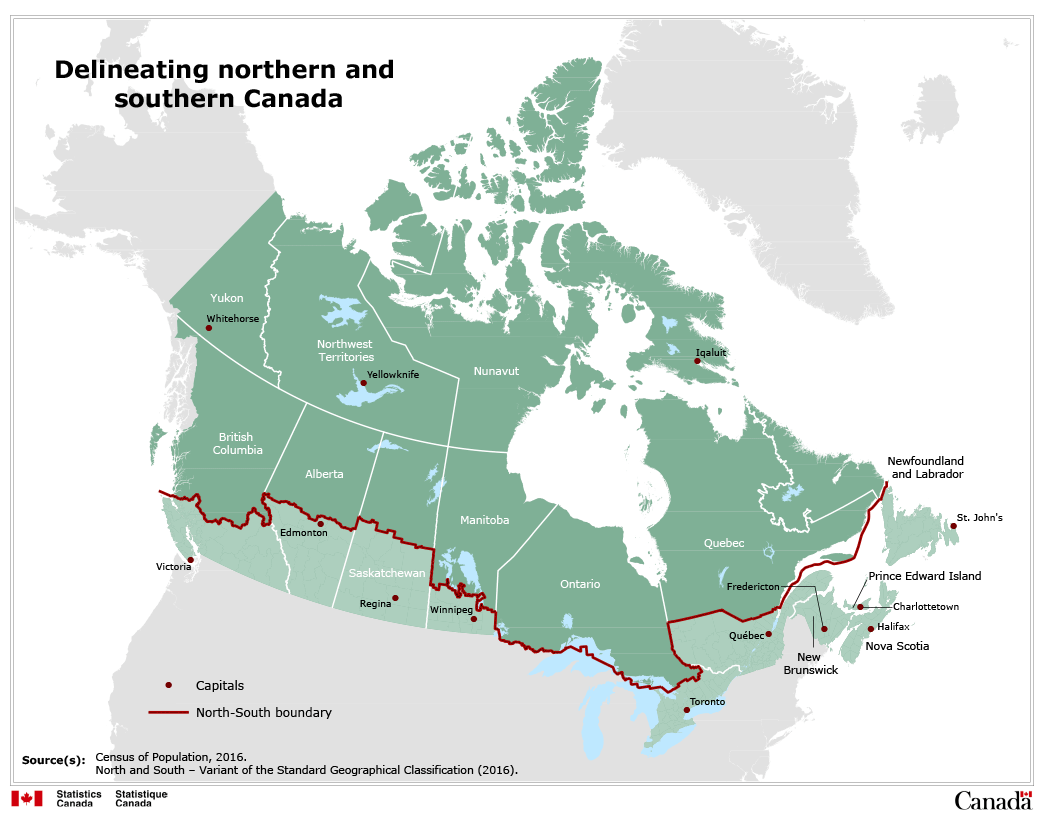
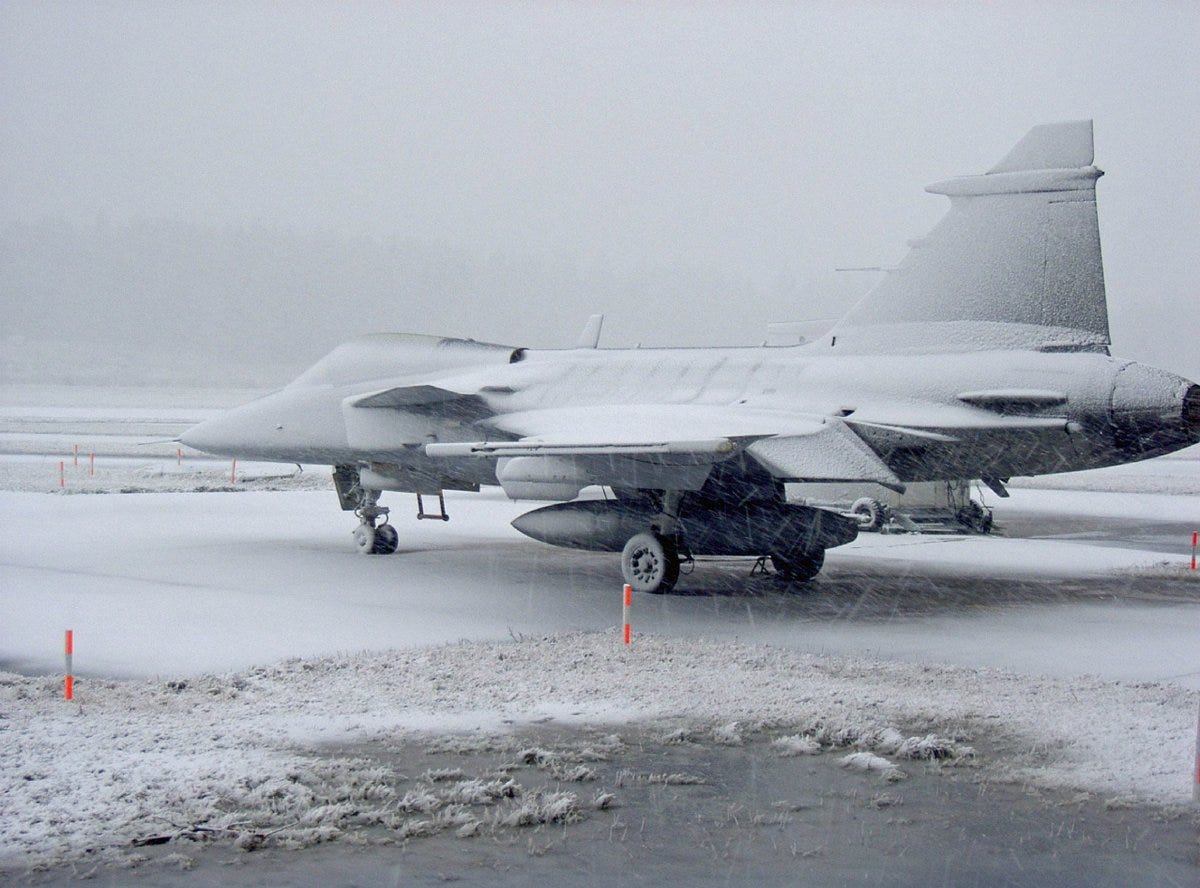
The Gripen is that kind of machine. It can land on a road. And I do mean a road, not a highway.
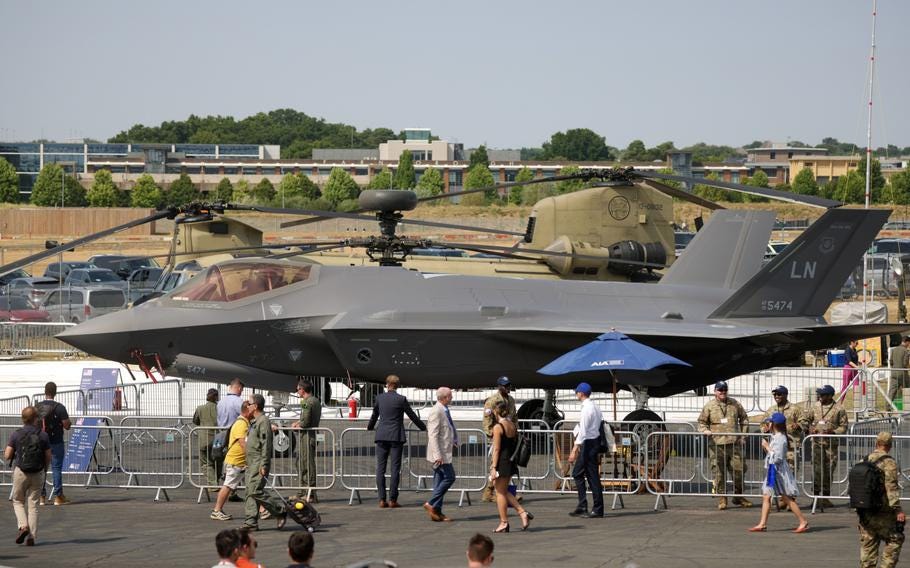
What about the showgirl? Well, you can’t walk on gravel in high heels.
- - -
To go back to where I began – choosing a fighter is complicated.
Here is a standard question: Is the F-35 a finer fighting machine than the Swedish Gripen? Probably.
But that is the wrong question. We don’t need a masterpiece. We don’t even need the finest fighting machine.
The idea that we must have the finest fighting machine, better than all others, misses the central point. Smart people don’t buy military equipment on an abstract theoretical basis which establishes the finest according to precise technical comparisons. In such a theory there is no need to apply your comparison to that country’s size, geography, climate, neighbours and actual needs or uses.
Does Canada need a fighter? Would drones do the job?
Ask rather, in what conditions will these fighters operate? And how can you handle their particular maintenance needs? Can they constantly operate in the places where you need them twelve months of the year? Etcetera etcetera…
- - -
The F-35 is not a fighter made for operating in the Arctic, let alone the North. It is a brilliant, delicate, spoilt child. It would need lovely warm hangars all over the place to insulate it from the brutal realities of the North. It needs not maintenance, but coddling. An impossibility in the North.
Can it sleep outside? Not in the reality of our northern conditions.
Can it land or take off on roads? I repeat, not highways.
How is it in treacherous weather? Distances?
The general answer?
The F-35 is a temperate climate fighter. How did that come about? Quite simple. It was designed with the USA in mind – a country of largely moderate climate.
The Canadian Air Force joined this program in the context of defending the main cities and population of its country, running along the country’s southern border. The Canadians did not think about a future in which their fighters would have to maintain a full time presence in the Arctic. An exotic idea! Far too exotic.
No. If they were going to defend democracy against communism or autocracy it would be in Europe on the eastern border facing the USSR or Russia. And, as in the U.S. and southern Canada, they would be flying in a close alliance with the U.S. Air Force.
Suddenly, here we are in a new world; one in which the Canadian Air Force is expected to defend Canada on two fronts. Well actually one front – The North – with three possible enemies.
A chaotic Russia. Unpredictable.
A rich and ambitious China, eager to be present in the North.
And an unstable USA which over the last 18 months has offended all of its allies, Canada in particular.
Mr. Trump’s claims on our near neighbour Greenland were just a start. Our neighbour? Look at the map. Greenland runs close and parallel to Baffin Island. Had Mr. Trump succeeded in getting control of Greenland, he would have claimed Baffin next.
His constant questioning of Canada’s right to exist might have been no more than a rude joke. Except that he keeps repeating his joke so that we understand it is a threat. When the most powerful man in the world keeps repeating threats in various forms against his country’s neighbour and closest ally, something serious is going on. And the Vice President, his probable successor, has let slip not even a hint that he is in disagreement.
You may not like Mr. Trump. He may be certifiable. Or verging on senility. But he is their Commander in Chief. And most important, U.S. citizens have not raised their voices in horror at his threats or in defence of Canada. They seem to be indifferent or at some level in agreement. Or they are afraid of him.
I repeat: There is no serious pro-Canada movement in the U.S.. That makes his threats powerful. That means it would be a terrible strategic error to become increasingly dependent on them for defence.
- - -
Let’s go back to Canada’s need to choose a new fighter. If ever there was a moment not to integrate into the U.S. Air Force system, it is now. Access to spare parts is perhaps the central issue. When your confidence in a country’s friendship begins to slide, it would be irresponsibly naïve to become dependent on it for military spare parts.
In any case, the last thing we should buy is a lovely racehorse when what we need are huskies.
The answers to all of these questions tell you that the F-35 is the sort of racehorse which is perhaps capable of winning competitive races on civilized tracks. What we need are huskies capable of operating in incredibly difficult weather and on incredibly difficult terrain.
The Gripen was designed by northerners for the North.
And as the U.S. empire’s need or ability or desire to lead an empire shrinks, so buying F-35s to defend Canada would become a strange strategy – a bit like a poodle that thinks it is in a fancy dog show, when it is actually in a dangerous slum.
We have a gigantic North to defend. We need equipment designed to function in our reality. It is that simple.
Add to this that the F-35 requires a huge crew for everyday operation and maintenance. Maintenance costs for the F-35 are huge compared to the Grippen. Yes. The F-35 is a high cost poodle show dog. The Gripen is a sled dog that will always get you where you have to go, including when nothing else can get you there. On a related note, it seems to me I remember reading something you wrote a long ago. It may have been in Voltaire’s Bastards. But you wrote of how we are really a Nordic country, and we should be hooking up with them to share technology, such as Arctic technology and that we really have more in common with these countries (including our social democratic leanings) than the US. While I always agreed with you, I have thought a lot recently of how 100% bang on you were. But not only that, about how Canadians seem to finally be understanding that.
Most Americans truly believe that being part of the United States is a blessing and why would anyone refuse? They are taken aback by our response and many are offended. I’ll take the Grippen.